

Blog
Advantages and uses of using a CNC router
Table of Contents
In modern manufacturing, traditional manual cutting and shaping methods are rapidly giving way to high-efficiency, automated systems. The advantages of using a CNC router span across multiple sectors, transforming raw sheet stock into highly accurate, complex components with minimal human intervention. By merging computer-aided design (CAD) with robust computer-aided manufacturing (CAM) workflows, CNC routers allow workshops to bypass the dimensional inaccuracies, high labor overhead, and material waste that typically plague manual fabrication.
Whether an operation involves small-scale custom cabinetry, high-volume furniture production, architectural sign making, or advanced composite machining, a CNC router serves as a foundational tool for business growth. Integrating this technology allows workshops to achieve extreme repeatability and speed, shifting their shop floor from an area of manual labor bottlenecks into a high-capacity, streamlined production center.
Quick Answer: What Are the Benefits of Using a CNC Router?
The primary benefits of using a CNC router include exceptional structural precision, high-speed automated throughput, minimal material waste via optimized nesting, and reduced labor reliance. By automating tool paths and cutting routines, these machines allow businesses to process wood, plastics, composites, and light metals faster and more consistently than traditional manual equipment.
Core Business Impacts of CNC Router Technology
Benefit | Business Impact | Industries That Benefit
|
|---|---|---|
High Precision | Exceptional part quality; zero dimensional variation | Cabinetry, Furniture, Aerospace |
Faster Production | Accelerated cycle times; massive volume throughput | Commercial Manufacturing, Case Goods |
Material Efficiency | Drastically reduced scrap rates through nested software | Sign Making, Architectural Millwork |
Automation | Lower labor costs; multi-process single setups | Industrial Fabrication, Prototyping |
Versatility | Processes diverse substrates on one machine platform | Wood, Plastics, Aluminum, Foam |
Top Benefits of Using a CNC Router
Understanding the full scope of CNC router advantages requires looking past basic cutting capabilities to see how digital automation redefines shop-floor economics.
Higher Precision and Consistent Accuracy
Manual woodworking and plastic machining are susceptible to human error, tool deflection, and operator fatigue. A CNC router operates on closed-loop servo or stepper motor drives that translate digital code into precise mechanical movements. This keeps cutting tolerances within fractions of a millimeter across the entire length of a standard 4×8 or 5×10 foot industrial table. Every pocket, dado, contour, and drill hole matches the digital schematic exactly, removing the variances common with handheld tools or manual saws.
Faster Production and Increased Throughput
Traditional production requires moving a workpiece between multiple distinct work zones—from a panel saw for rough sizing, to a drill press for boring, and finally to a shaper or router table for edge profiling. An industrial CNC router handles all of these steps sequentially in a single material setup. High-frequency spindles running at up to 24,000 RPM plow through dense materials at rapid feed rates, compressing production schedules that once took days into a matter of hours.
read more: Best CNC Router for Sign Making
Reduced Material Waste
Material cost represents a major ongoing expense for any fabrication business. CNC routers minimize this overhead by utilizing “true-shape” nesting algorithms within the CAM software. The system automatically calculates the most efficient layout for dozens of mixed parts on a single sheet, packing them tightly together. This level of optimization reduces scrap rates from a typical 20–25% down to less than 10%, creating direct monthly savings on sheet goods like plywood, MDF, acrylic, and aluminum.
Lower Labor Costs Through Automation
The manufacturing sector continues to face an ongoing shortage of skilled machinery operators. CNC routers bridge this gap by replacing manual, highly repetitive labor with automated machine cycles. Once an engineer programs a nested file, a single operator can manage loading, running, and unloading the machine. Advanced hardware configurations further minimize manual steps through vacuum hold-down tables and automatic tool changers (ATC).
Greater Design Flexibility and Customization
With a CNC router, switching from high-volume batch production to a one-off custom piece requires nothing more than loading a new software file. Complex three-dimensional carving, intricate geometric fretwork, and sweeping organic curves are easily carved via digital toolpaths. This agility allows shops to offer profitable custom options without slowing down their standard production lines.
Improved Repeatability for Mass Production
For commercial cabinetry or contract furniture manufacturing, part number 1 must match part number 1,000 exactly. Because a CNC router relies completely on digital code, toolpath execution remains identical week after week. This consistency eliminates the time spent hand-fitting parts during assembly, making it easy to run automated, standardized production lines.
Common Uses of CNC Routers Across Industries
- Cabinetry and Commercial Case Goods: In the cabinet-making industry, speed and squareness are vital. CNC routers process sheet goods by cutting out cabinet box panels, drilling 32mm system holes for shelf pins, boring hinge pockets, and milling dados for back panels all in one continuous program.
- Furniture Manufacturing: From solid wood chair components to engineered frames for upholstered seating, CNC routers easily tackle the irregular shapes and complex curves common in furniture design.
- Sign Making and Exhibition Displays: The sign industry relies heavily on a wide variety of materials. CNC routers excel at cutting dimensional letters, engraving detailed graphics, and profiling nesting layouts out of foam boards, plastics, aluminum composites (ACM), and hardwoods.
- Plastics and Composites Processing: Advanced plastics like HDPE, polycarbonate, acrylic, and PVC expand and contract under thermal stress, making them tricky to machine by hand. CNC routers maintain precise feed-to-speed ratios to avoid melting or chipping material edges.
- Non-Ferrous Metal Fabrication: While not built to replace heavy milling machines for steel, industrial CNC routers are excellent for cutting non-ferrous metals like aluminum, brass, and copper.
How CNC Routers Improve Manufacturing Efficiency
Evaluating the real benefits and uses of using a CNC router requires looking at how these machines modernize an entire workshop workflow. Traditional production relies on manual layouts, physical templates, and repetitive measurements—all processes vulnerable to human error. A CNC system integrates into a modern, fully digital workflow.
When checking out advanced CNC Routers and Blade Cutters for industrial production, the efficiency gains become clear right away. This single machine replaces several older tools like table saws, shapers, and manual boring machines, saving valuable floor space and reducing material handling risks. Furthermore, integrating your machine with modern ERP and manufacturing software allows you to generate automated cut-lists directly from a customer’s digital order.
Selecting the Right CNC Router Architecture
Entry to Mid-Level Custom Production
For smaller workshops, boutique sign shops, or custom furniture makers, space efficiency and versatile material handling are top priorities. Shops in this category require an industrial-grade frame that can process smaller parts and custom details without a massive footprint. High-tech options like the HT-R3Q CNC Router Engraving Machine provide excellent entry-level rigidity and multi-axis precision, allowing businesses to step away from manual saws and hand routers to ensure perfectly square parts on every run.
High-Efficiency Commercial Shops
Growing businesses that regularly handle mid-volume cabinet runs or commercial signage need to minimize downtime between cycles. These operations benefit from expanded bed sizes and fast tool management. The HT-R3Q Plus CNC Router Engraving Machine steps up to meet this demand, offering enhanced frame stability and integrated tool options. This allows operators to easily manage complex profiles and variable depth carves across different materials without manually stopping the machine to swap bits.
High-Volume Industrial Plants
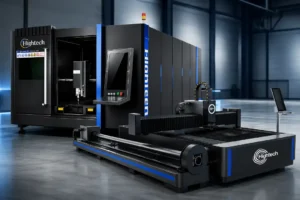
For large factories, architectural mills, and around-the-clock fabrication plants, maximizing sheet throughput per hour is the primary goal. These environments require heavy-duty engineering built for continuous operation under heavy loads. The HT-R6 CNC Router Engraving Machine represents the top tier of industrial performance, featuring a heavy-duty chassis, powerful high-speed servo drives, and a rapid automatic tool changer. It handles automated nesting and high-velocity cutting shifts day after day, turning out clean, perfectly machined parts with zero structural deflection.
Maximizing Your Long-Term Return on Investment (ROI)
Purchasing an industrial CNC system is an investment in your business’s long-term capacity and market competitiveness. While the initial cost of a high-quality machine requires a capital investment, the payback period is often short. Most commercial workshops find their investment pays off within 8 to 14 months through predictable operational savings in increased capacity, fewer material re-cuts, and expanded product lines.
Partnering with an experienced manufacturer like HT Industry CNC Solutions ensures you get a machine tailored to your exact production goals. Choosing a well-built system with a strong chassis, reliable guide rails, and a high-performance spindle gives your workshop a dependable production asset that will drive profitability for years to come.
Find the Right Machine for Your Application
Frequently Asked Questions
What are the main benefits of using a CNC router?
The main advantages include exceptional cutting precision, faster production times, and significantly lower labor costs through automation. CNC routers also use nesting software to minimize material waste and offer the design flexibility to cut wood, plastics, composites, and soft metals on a single machine.
What can a CNC router be used for?
A CNC router is exceptionally versatile and can be used to manufacture kitchen cabinets, office furniture, custom architectural millwork, dimensional signage, plastic components, and 3D prototyping molds. It handles processes like pocketing, profiling, drilling, and intricate 3D carving with ease.
Which industries benefit the most from CNC routers?
The cabinetry, furniture manufacturing, sign-making, plastic fabrication, and non-ferrous metal industries benefit the most. Any business that processes sheet materials or needs to make repeatable, highly accurate cuts can improve their workflow with a CNC router.
Is a CNC router worth the investment for a small business?
Yes. For small businesses, a CNC router replaces several manual woodworking tools and reduces the need for large production teams. By cutting down on material waste and speeding up production, it allows small shops to handle larger, more profitable commercial contracts.
Can a CNC router reduce material waste and labor costs?
Yes. CNC nesting software automatically arranges components to get the absolute most parts out of every sheet, dropping material waste below 10%. Additionally, because the machine handles cutting, drilling, and profiling automatically in a single setup, labor costs drop significantly since one operator can manage the entire process.
Latest contents