
Blog
How to Choose a Laser Welding Machine: A Practical Buyer’s Guide
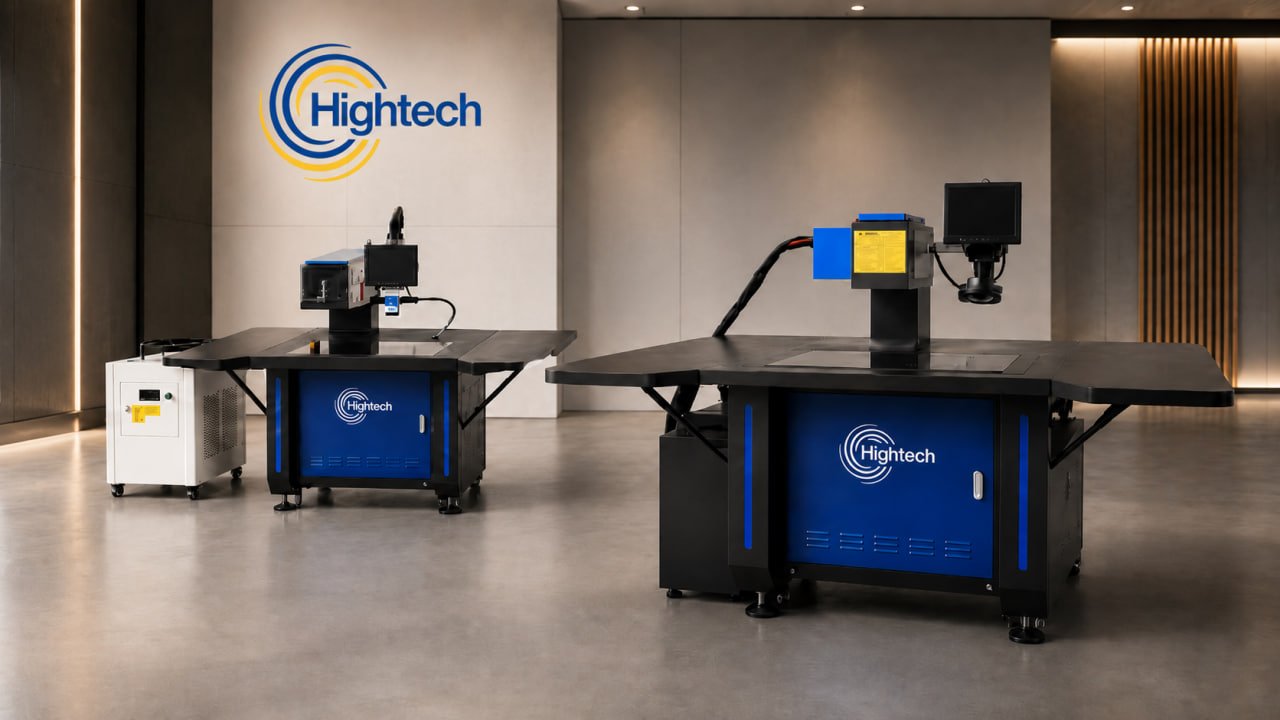
Table of Contents
Choosing the right laser welder starts with the workpiece, not the wattage label. Material, thickness, joint geometry, production volume, finish requirements, operator access, and support all determine whether a machine will improve output or become an expensive mismatch. HT Industry’s laser welding machines range covers handheld fiber systems, table-based fiber equipment, QCW and YAG machines, and specialized jewelry welders, so buyers can match the process to the application rather than force every job onto one platform.
Use this six-step framework to shortlist a machine, then confirm the decision with sample welds on your actual alloy, joint, gap, gas, and required travel speed. For a deeper model comparison, see the best fiber laser welding machine buyer’s guide.
QUICK FACT
- Start with the real workpiece and joint—not the highest available wattage.
- Use published thickness limits only to shortlist models; validate with sample welds.
- Compare the complete installed system: safety controls, extraction, utilities, training, warranty, and support.
Step 1: Define the Materials, Thicknesses, and Joint Types
Stainless steel and carbon steel
Start by listing the minimum and maximum thickness, the percentage of each material in the workload, and the joints you produce most often. Stainless and carbon steel are generally strong candidates for fiber laser welding because they absorb near-infrared energy efficiently and can be joined at high speed with a narrow heat-affected zone. Fit-up still matters: butt joints with inconsistent gaps may require filler wire, while overlap, corner, edge, spot, and T-joints may need different nozzles, oscillation widths, and access angles.
Evaluate the complete workload rather than one ideal sample. Record the required bead appearance, penetration, distortion limit, and whether the weld must pass a destructive or leak test.
Aluminum, copper, brass, and other reflective metals
Reflective metals need careful validation. Aluminum conducts heat quickly, while copper and brass can reflect more laser energy. Review laser welding material compatibility before selecting a system, and ask the supplier to test your exact grade and surface finish. A generic material list cannot guarantee the same penetration, strength, or appearance across every alloy.
Step 2: Choose the Right Laser Technology and Operating Mode
Fiber laser welding machines
HT Industry’s handheld HT FW series is the practical starting point for general metal fabrication. These systems combine a handheld gun, water cooling, a double-drive wire feeder, built-in parameters, and a 5–10 m fiber cable. They support common spot, butt, overlap, edge, corner, and T-joints.
Choose handheld fiber when flexibility and access to irregular workpieces matter more than fixture-controlled repeatability, especially for short runs, repairs, and custom fabrication.
YAG and QCW laser welding machines
QCW and YAG platforms are better suited to applications that need controlled pulse energy, precise spot placement, or low heat input. The QCW Laser Welding Machine HT750W uses a sealed laser module and is positioned for energy-efficient, low-maintenance precision work. The dual-mode HT QCW 750Y can switch between a CCD-equipped stationary platform and a handheld configuration. HT Industry’s YAG HT-YG500W offers handheld and table welding, CCD positioning, pulse adjustment, and published penetration up to 4 mm for suitable applications.
Step 3: Match Laser Power to Material Thickness and Throughput
1000W–1500W: thin sheet and general light fabrication
A 1500W system fits signage, cabinets, kitchenware, light frames, and mixed thin-sheet production. HT Industry publishes screening limits for the HT FW 1500 laser welding machine of up to 4 mm stainless steel, 4 mm carbon steel, and 3 mm aluminum. Actual capacity depends on alloy, joint design, fit-up, focal position, oscillation pattern, wire, shielding gas, and travel speed.
2000W: versatile production and medium-thickness work
The HT FW 2000 fiber laser welder is the broader all-round option for busy shops that need higher travel speed or more penetration while retaining handheld flexibility. Published screening figures are up to 6 mm stainless steel, 6 mm carbon steel, and 5 mm aluminum. Select 2000W when work regularly exceeds light-gauge sheet or faster cycles justify the added power.
3000W and above: heavy-duty and high-volume applications
The HT FW 3000 industrial laser welder is designed for demanding production, larger assemblies, and thicker steel. HT Industry publishes up to 8 mm for stainless and carbon steel. Higher power can increase speed and penetration, but also demands more attention to electrical capacity, cooling, guarding, and parameter control. Avoid 3000W if most work is thin sheet.
Step 4: Select Handheld, Table-Based
Handheld laser welders for flexible fabrication and repair
Handheld systems are best when parts vary in size or cannot be loaded into a fixed workstation. Evaluate gun weight, grip angle, cable length, wire feeding, nozzle selection, and stand-off control. The HT FW series uses an integrated cabinet and long fiber cable, making it suitable for mobile work around large components while the machine remains stationary.
Table welding machines for controlled precision and repeatability
A fixed table improves stability for delicate parts, visible seams, channel letters, and repeatable work. The Fiber Table Welding Machine HT FWT-1500 combines 1500W fiber power with CCD vision, a double-swing head, 0–120 mm/s published welding speed, and a stated 0.4–8 mm thickness range. It is a better fit than a handheld gun when accurate positioning and a consistent viewing setup matter more than mobility.
Step 5: Verify Safety Features and U.S. Compliance Documentation
Laser classification, interlocks, emergency stop, guarding, and key control
Industrial laser welders can present Class 4 beam hazards. For U.S. import, ask for the model-specific FDA laser product report accession number, required labels, manual, and evidence that the delivered configuration matches the reported model. An accession number confirms receipt of a report; it is not FDA approval. Also verify protective housing or guarding, safety interlocks, emission indicators, key control, emergency stop, and a safe method for enabling the beam.
Wavelength-rated eye protection, controlled work area, and fume extraction
Select eyewear for the wavelength and optical density identified by a qualified laser-safety assessment; it does not replace engineering controls. Prevent direct and reflected exposure through access control, reflective-surface control, screens, or an enclosure. Provide local exhaust ventilation for welding fumes and metal particulates, and confirm that airflow does not disrupt shielding gas.
Training, manuals, installation support, and risk assessment
Before commissioning, assign laser-safety responsibility, document procedures, train operators, and complete a task-specific risk assessment. Supplier setup training is useful, but it is not a complete workplace safety program.
Step 6: Evaluate the Manufacturer, Warranty, and After-Sales Support
Warranty coverage and exclusions
HT Industry lists a one-year warranty and lifetime technical support for its machines, with exclusions such as consumables, accidental damage, improper operation, unstable power, and unauthorized modification. Obtain the warranty in writing and confirm coverage for the source, chiller, head, optics, controls, wire feeder, labor, shipping, and replacement-part freight.
Training, remote diagnostics, spare parts, and response time
Support quality affects uptime more than brochure language. Confirm support hours, response time, remote diagnostics, software access, spare-parts inventory, and local-service availability. Review the recommended laser welding machine maintenance schedule and identify the protective lenses, nozzles, coolant, filters, and other items your team must stock.
Questions to ask before requesting a quote
Send an application file with material grades, thicknesses, drawings, joints, gaps, volume, cycle time, required tests, facility voltage, and installation location. Request a sample-weld report, machine configuration, included accessories, safety package, utilities, delivery terms, commissioning plan, training scope, warranty, and itemized optional equipment. This produces a comparable quotation and reduces surprises after delivery.
Which HT Industry Laser Welding Machine Fits Your Application?
Use the table below as a first-pass decision tool. Final selection should follow a sample weld test and a written review of facility, safety, and support requirements.
Model | Format | Power | Best fit | Published screening capacity |
|---|---|---|---|---|
HT FW 1500 | Handheld CW fiber | 1500W | Thin/light-to-general fabrication | Up to 4 mm SS/CS; 3 mm Al* |
HT FW 2000 | Handheld CW fiber | 2000W | Mixed medium-thickness production | Up to 6 mm SS/CS; 5 mm Al* |
HT FW 3000 | Handheld CW fiber | 3000W | Heavy-duty/high-throughput steel | Up to 8 mm SS/CS* |
HT FWT-1500 | Fixed table fiber + CCD | 1500W | Precision/signage/decorative parts | Published 0.4–8 mm range* |
HT QCW 750 / 750Y | QCW pulsed / dual-mode | 750W | Precision, spot, repair, controlled heat | Application-specific testing |
HT JW MD 200 | Jewelry fiber laser | 200W class | Jewelry repair and micro-welding | Fine, heat-sensitive components |
HT FW 1500 for light-to-general fabrication
Choose the HT FW 1500 for thin-to-moderate sheet, handheld access, signage, cabinets, frames, kitchenware, repair, and mixed custom work.
HT FW 2000 for versatile, higher-throughput fabrication
Choose the HT FW 2000 when 1500W would often run near its limit or when faster medium-section production is the priority.
HT FW 3000 for heavy-duty production
Choose the HT FW 3000 for sustained industrial workloads, thicker steel, large assemblies, or high throughput, after confirming utilities, extraction, guarding, and process controls.
HT FWT-1500, QCW, YAG, and jewelry welders for specialized work
Choose the HT FWT-1500 for CCD-assisted table work and repeatable precision parts. Select QCW or YAG equipment for controlled pulse energy, repair, spot welding, and heat-sensitive components. For rings, chains, settings, and precious-metal repair, the compact jewelry laser welding machine HT JW MD 200 adds a 10× microscope and CCD viewing system for close visual control.
Common Laser Welding Machine Buying Mistakes to Avoid
Avoid these three errors when comparing quotations and selecting a machine:
- Buying the highest wattage without validating the application. Excess power can raise cost, facility burden, and thin-part burn-through risk without solving the real bottleneck.
- Ignoring material reflectivity, fit-up, and sample testing. A published material list does not prove that your alloy, coating, gap, and joint will meet strength and appearance requirements.
- Comparing purchase price but not total ownership cost. Include extraction, guarding, utilities, consumables, training, freight, downtime, and spare parts.
Find the Right Machine for Your Application
Frequently Asked Questions
What type of laser welding machine is best for metal fabrication?
For general fabrication with changing part sizes, a handheld continuous-wave fiber laser welder is usually the most practical choice. Select a table system when precision positioning and repeatability are more important than mobility, and use QCW, YAG, or jewelry systems for pulse-controlled, fine, or heat-sensitive work.
Should I choose a 1500W, 2000W, or 3000W laser welder?
Choose 1500W for thin-sheet and light general fabrication, 2000W for mixed medium-thickness production and higher throughput, and 3000W for thicker steel or demanding industrial duty. Validate the choice with your actual parts because alloy, joint, gap, gas, wire, and travel speed affect capacity.
Is a handheld or table laser welding machine better for my shop?
A handheld machine is better for large, irregular, or frequently changing workpieces. A table machine is better for small parts, decorative work, channel letters, and jobs where a fixed viewing and fixturing setup improves consistency.
What safety equipment and workplace controls are required for laser welding?
A safe installation typically requires a controlled laser area or enclosure, interlocks and emergency controls, wavelength-rated eyewear selected through a laser-safety assessment, reflective-surface control, ventilation or local exhaust, documented procedures, training, and a model-specific risk assessment. Requirements depend on the machine and workplace.
What should I ask a supplier before purchasing a laser welding machine?
Ask for sample welds, model-specific specifications, FDA reporting and labeling documentation for U.S. import, included safety features, electrical and cooling requirements, accessories, warranty terms, training, support response time, spare-parts availability, delivery terms, and a complete itemized quote.
Latest contents