

Blog
Laser Engraving vs Laser Marking: Key Differences and How to Choose
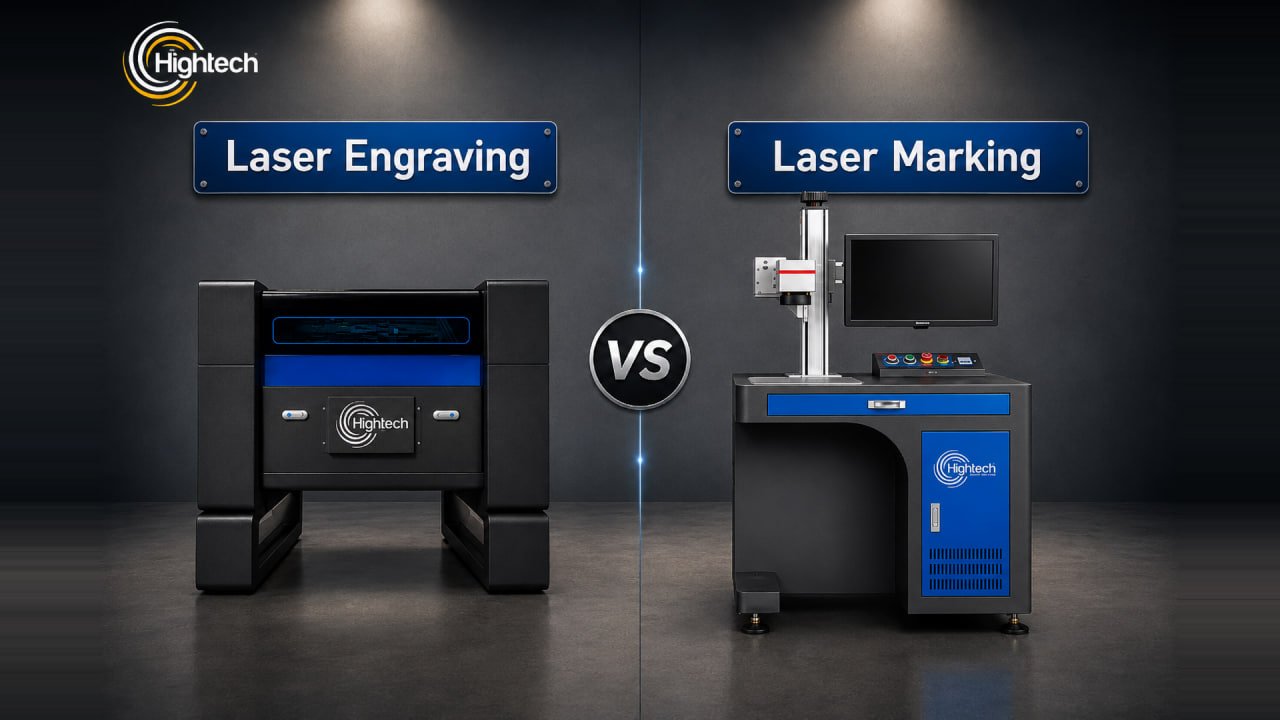
Table of Contents
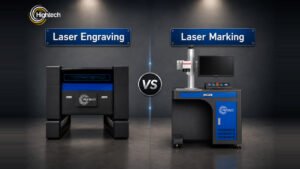
Laser engraving and laser marking both create permanent text, graphics, identification codes, and decorative effects, but they do not alter a surface in the same way. Engraving removes material to create a recessed result, while marking usually changes the surface color, chemistry, or a very thin top layer. The better choice depends on the substrate, required depth, production speed, mark contrast, and exposure conditions. HT Industry’s range reflects this difference: fiber and MOPA systems are aimed mainly at metal processing, UV equipment supports fine low-heat marking, and CO2 machines are suited to many organic and non-metal materials.
Quick Facts: Laser Engraving vs Laser Marking at a Glance
Factor | Laser Engraving | Laser Marking |
|---|---|---|
| Surface effect | Removes material and creates a recess | Changes color, chemistry, or a thin surface layer |
| Feel | Usually tactile | Usually smooth or minimally textured |
| Typical priority | Depth and wear resistance | Speed, contrast, and low surface impact |
| Common lasers | Fiber or CO2, depending on material | Fiber, MOPA, UV, or CO2 |
| Best-fit examples | Deep metal IDs, plaques, wood graphics | Serial numbers, QR codes, logos, electronics |
What Is Laser Engraving?
How the Laser Engraving Process Works
Laser engraving focuses enough energy on the workpiece to melt, vaporize, or ablate material along a programmed path. Repeated passes can increase depth, while line spacing, power, frequency, speed, and focus determine how quickly material is removed and how clean the finished recess appears. For metals, a fiber source is commonly selected; for wood, acrylic, leather, fabric, paper, and many other non-metals, a CO2 system is usually the practical match.
Engraving Depth, Texture, and Surface Finish
Because engraving removes material, the finished design can be felt by touch. The result may be a shallow etched-looking recess, a deep industrial identification mark, or a textured decorative area. High depth improves resistance to abrasion and refinishing, but excessive heat or repeated passes can create burrs, discoloration, edge roughness, or distortion. Process development should therefore balance depth with cycle time and part quality.
What Is Laser Marking?
How the Laser Marking Process Works
Laser marking creates a readable result with little or no measurable removal. The beam may oxidize a metal surface, change a polymer’s color, darken an anodized layer, foam a plastic, or remove a coating to reveal a contrasting substrate. HT Industry’s laser marking machines include fiber, MOPA, UV, and CO2 configurations, giving buyers options for metals, coated products, plastics, and organic materials.
Common Laser Marking Methods: Annealing, Coloration, Foaming, Carbon Migration, and Ablation
Annealing creates dark oxide marks on metals with minimal surface disruption. Coloration uses controlled thermal effects, especially with an adjustable-pulse MOPA laser marking machine, to create color or black marks on suitable metals and anodized aluminum. Foaming forms light raised marks in some plastics, while carbon migration produces darker polymer marks. Surface ablation removes paint, anodizing, or another thin coating without cutting deeply into the base material.
Laser Engraving vs Laser Marking: Detailed Comparison
Process and Surface Alteration
Engraving removes part of the substrate. Marking modifies the surface or removes only a thin coating. This distinction affects appearance, cleaning, corrosion behavior, and whether the mark can be felt.
Mark Depth and Tactile Finish
Engraving is the better option when a recessed, tactile result is required. Marking is preferred when the component should remain smooth, such as an electronic housing, medical component, or finished consumer product.
Durability, Wear Resistance, and Environmental Exposure
A sufficiently deep engraving remains legible after abrasion, paint, or moderate refinishing. A high-quality marked code can also be permanent, but its resistance depends on the marking mechanism, coating system, material, and operating environment.
Speed, Cycle Time, and Production Throughput
Marking normally requires less energy per unit area and fewer passes, so it is generally faster for serial numbers, logos, and machine-readable codes. Engraving becomes slower as target depth increases.
Precision, Contrast, and Heat-Affected Area
Marking systems can create small characters and high-contrast codes with limited heat input. HT Industry lists line speeds up to 7,000 mm/s for its fiber, MOPA, and UV marking models, while the CO2 marking model is specified up to 12,000 mm/s. Actual production speed depends on artwork, fill density, material, lens, and quality requirements.
read more: industrial laser marking machines
Material Compatibility
The laser wavelength must suit the material. Fiber and MOPA sources are strong choices for metals. UV systems are useful for fine, low-heat work on many plastics, coated products, glass, and sensitive components. CO2 systems are commonly used for acrylic, wood, MDF, plywood, leather, fabric, paper, cardboard, rubber, and selected plastics.
Equipment, Laser Type, Power, and Settings
HT Industry’s standard fiber marking model is offered in 30 W and 50 W versions for metal engraving and marking. Its MOPA machine adds broad pulse-duration control for fine processing, color marking, and anodized-aluminum blackening. The UV model uses a 355 nm source in 3-10 W configurations for fine detail, while CO2 marking and engraving systems address organic and non-metal production.
Upfront Cost, Operating Cost, Maintenance, and Consumables
Purchase price should be evaluated together with throughput, service, ventilation, cooling, optics, replacement sources, and rejected-part risk. A lower-cost machine is not economical if it cannot process the main material or meet the required code quality. Ask for sample testing before purchase and confirm the final power, work area, software, accessories, warranty, and support package in the quotation.
Best Materials for Laser Engraving and Laser Marking
Metals: Stainless Steel, Aluminum, Brass, Titanium, and Coated Metals
Fiber lasers are commonly used for direct metal marking and engraving. HT Industry’s fiber model is presented for iron, steel, aluminum, copper, brass, precious metals, ceramics, plastics, and rubber. For more control over pulse duration, the MOPA laser marking machine is designed for stainless-steel color marking, anodized-aluminum blackening, precision stripping, deep metal engraving, and delicate electronic applications.
Plastics and Engineered Polymers
Plastic response varies by resin, pigment, additives, and flame-retardant package. A fiber laser may darken or foam compatible plastics, while a UV laser marking machine can produce fine marks with a small heat-affected zone. HT Industry’s UV model has a 355 nm wavelength, a listed line width of 0.01 mm or less, and software functions for serial numbers and production dates, making it relevant to detailed identification tasks. Always test the exact resin formulation.
Wood, Acrylic, Leather, Glass, and Other Non-Metals
For signs, gifts, packaging, textiles, leather goods, and woodworking, CO2 laser cutting and engraving machines offer the broadest flexibility. HT Industry lists models from compact 400 × 600 mm systems to 1500 × 3000 mm large-format machines, with applications that include cutting, line engraving, raster engraving, and surface marking. A dedicated CO2 laser marking machine is another option for fast marking on leather, wood, plastic, and two-color board.
Applications and Industry Use Cases
Serial Numbers, Barcodes, QR Codes, UID Codes, and Part Traceability
Laser marking is usually the first choice for high-volume traceability because it produces precise, repeatable codes without labels or inks. Dynamic data software can generate sequential numbers, dates, and identifiers. Engraving is appropriate when a code must remain readable after severe abrasion, coating, or outdoor exposure.
Branding, Signage, Personalization, and Decorative Work
Engraving gives plaques, awards, wood products, leather, acrylic, and metal gifts a tactile premium finish. Marking is efficient for logos on tools, electronics, nameplates, and coated products. Sign shops often need both capabilities: CO2 equipment for acrylic and wood, and fiber or MOPA equipment for metal plates and components.
Advantages and Disadvantages
Process | Advantages | Disadvantages |
|---|---|---|
| Laser engraving | Deep tactile highly wear-resistant strong decorative effect remains visible after surface wear | Slower at greater depths removes material can increase heat debris finishing needs |
| Laser marking | Fast precise high contrast minimal surface disruption well suited to serial data and automation | Usually little depth performance depends on material chemistry and coatings may be less resistant to aggressive resurfacing |
How to Choose Between Laser Engraving and Laser Marking
Choose Laser Engraving When Depth and Maximum Wear Resistance Matter
Select engraving for parts exposed to abrasion, repainting, refinishing, or harsh handling; for tactile identification; or when the design itself requires a recessed decorative finish. For metal, review fiber power and the number of passes needed. For non-metals, choose a CO2 format that accommodates the sheet size, object height, and production volume.
Choose Laser Marking When Speed, Contrast, and Surface Integrity Matter
Select marking for serial numbers, barcodes, QR codes, logos, dates, and fine graphics when high throughput and low surface impact are priorities. Standard fiber systems suit many metals, MOPA expands pulse control for sensitive and color applications, UV supports fine low-heat work, and CO2 marking suits many organic materials.
Selection Checklist: Material, Depth, Durability, Contrast, Volume, Compliance, and Budget
Start with the exact material and coating. Define whether the mark must be tactile, its required contrast, the smallest code size, and the daily quantity. Then evaluate laser type, power, lens and field size, rotary needs, ventilation, cooling, software integration, operator training, maintenance, and total cost of ownership. Review this guide to fiber laser vs CO2 laser when the main decision is between metal and non-metal work. The safest purchasing step is to send representative samples and artwork for testing before finalizing the machine configuration.
Find the Right Machine for Your Application
Frequently Asked Questions
What is the main difference between laser engraving and laser marking?
Engraving removes material and creates depth. Marking usually changes color or a very thin surface layer with minimal removal.
Is laser marking the same as laser engraving?
No. The terms are sometimes used loosely, but the processes produce different depths and surface effects.
How deep can laser engraving go compared with laser marking?
Engraving can range from shallow recesses to multi-pass deep marks. Marking is generally surface-level, although equipment specifications and terminology vary.
Which process creates the most durable and permanent mark?
Deep engraving offers the best resistance to heavy abrasion. A correctly developed laser mark can still be permanent for normal industrial use.
Which is faster: laser engraving or laser marking?
Laser marking is generally faster because it uses less material removal and often fewer passes.
Which process is best for metal parts?
Fiber marking is a strong default for metals. Choose MOPA for greater pulse control, color effects, or sensitive surfaces; choose deep fiber engraving when depth is essential.
Can plastics be laser marked or laser engraved?
Yes, but results depend on the exact polymer and additives. UV, fiber, and CO2 lasers each suit different plastic families, so sample testing is essential.
Which method is better for serial numbers, barcodes, and QR codes?
Marking is usually better because it is fast, precise, and easy to automate. Engraving is used when the code needs extra depth.
What is the difference between laser marking, laser engraving, and laser etching?
Marking is the broad category. Engraving removes more material for depth, while etching usually creates a shallower melted or ablated surface effect.
What type of laser is used for engraving and marking?
Fiber and MOPA lasers are common for metals, UV for fine low-heat marking, and CO2 for many non-metals.
How do I choose between laser engraving and laser marking for my application?
Match the laser to the material, then define depth, contrast, durability, speed, code size, production volume, and budget. Confirm the choice with sample tests.
Latest contents