

Blog
Fiber laser vs CO2 laser: which for signage?
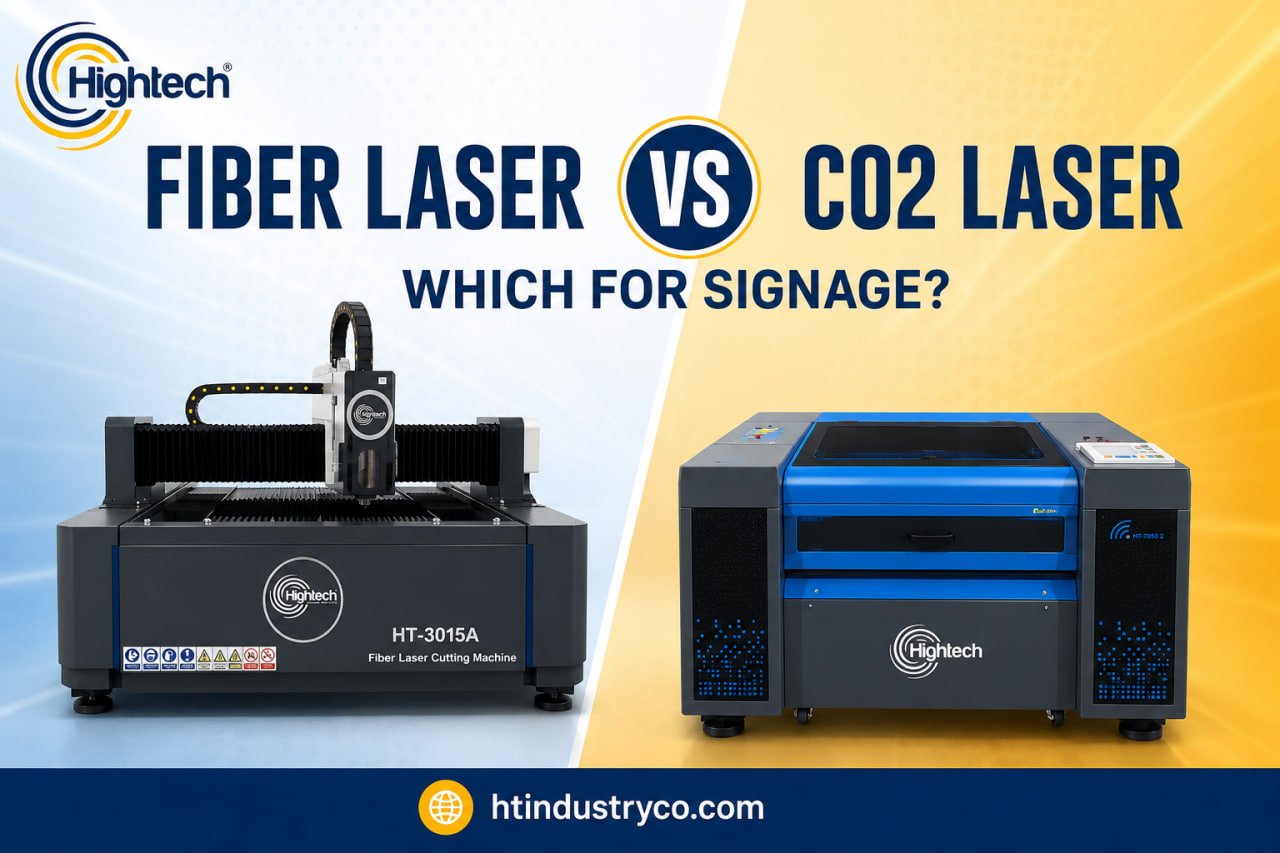
Table of Contents
Choosing between a fiber laser vs CO2 laser for signage depends mainly on the materials your sign shop processes. CO2 lasers are generally the better choice for acrylic faces, wooden signs, MDF, fabric, and other non-metal materials. Fiber lasers are designed for metal signage, including stainless-steel letters, aluminum panels, brass plaques, and structural sign components.
Neither technology is universally better. A shop focused on illuminated acrylic signs may benefit most from a CO2 system, while a metal fabrication business will usually need a fiber laser. Sign companies working with both metal and non-metal materials may eventually require both technologies.
This guide compares fiber and CO2 lasers based on signage materials, cutting quality, production workflow, maintenance, and business requirements.
The Signage Dilemma
When you’re outfitting a sign shop, the laser is the single biggest decision you’ll make. Buy a CO2 and that lucrative run of brushed-stainless storefront letters slips to a competitor.
Here’s the one-line verdict to anchor on: CO2 lasers dominate organic materials (acrylic, wood, plastics), and fiber lasers dominate metals (stainless, aluminum, brass). Now let’s get into why that’s true, where the line blurs, and what it means for your bottom line.
The Core Difference — Wavelength & Material Match
Everything comes down to a single number: the wavelength of light the laser produces.
A CO2 laser emits infrared light at roughly 10.6 µm. That wavelength is readily absorbed by organic materials — acrylic, wood, plastics, glass, fabric, paper. The energy converts cleanly into heat at the material surface, which is why CO2 cuts crisp acrylic edges and engraves wood beautifully.
A fiber laser emits at roughly 1.06 µm — about ten times shorter. That shorter wavelength is strongly absorbed by metals, which reflect and shrug off the CO2 wavelength. This is why fiber rips through stainless and aluminum that a CO2 laser can barely mark.
The plain-English takeaway: the laser has to match what the material absorbs. No amount of extra wattage makes a fiber laser cut acrylic well, and no marking agent fully closes the gap when you ask a CO2 laser to work bare metal.
One more structural difference worth knowing: a fiber laser is solid-state, generating its beam through fiber optics with very few moving parts. A CO2 laser relies on a sealed gas tube and a path of mirrors that must stay aligned. That design gap drives much of the maintenance and lifespan story you’ll see in the cost section below.
Head-to-Head Comparison for Signage
Factor | CO2 Laser | Fiber Laser |
|---|---|---|
Best signage materials | Acrylic, wood, plastics, glass, fabric | Stainless steel, aluminum, brass, copper |
| Acrylic edge quality | Excellent — flame-polished, clear edges | Not suitable for cutting acrylic |
| Metal cutting/marking | Limited; needs marking agents on bare metal | Excellent — fast, clean, permanent |
| Engraving detail | Great on organics | Great on metals (fine text, logos) |
| Cutting speed (metal) | Slower | Significantly faster |
| Upfront cost | Lower entry point | Higher initial investment |
| Maintenance | Tube replacement, mirror alignment, gas | Near-zero consumables, no mirror alignment |
| Energy use | Higher | Lower (notable annual savings) |
| Lifespan | Shorter source life | Longer source life |
| Ideal sign shop use | Illuminated acrylic signs, channel letter faces, wood signage | Metal storefront letters, brass plaques, ADA & industrial signage |
Best Laser for Different Sign Materials
The best laser for sign making depends on how the material absorbs the laser wavelength. Using the correct technology improves cutting quality, reduces production time, and prevents equipment damage.
Acrylic & Wood — Why CO2 Wins
If illuminated signage is your bread and butter, CO2 isn’t a preference — it’s a requirement.
The decisive advantage is edge quality on acrylic. As a CO2 beam cuts cast acrylic, it momentarily melts the cut face, leaving a glossy, flame-polished edge with no secondary finishing. For a lit channel-letter face or an edge-lit illuminated sign, that polished edge is what makes light travel cleanly and the sign look premium. A fiber laser simply can’t produce this — its wavelength isn’t absorbed by acrylic the way it needs to be, so cutting acrylic on fiber is not a viable workflow.
CO2 is equally at home on wood, handling both engraving and cutting for rustic storefront signs, dimensional lettering, and layered plaques. The same goes for plastics, laminates, and a range of substrates a sign shop touches daily.
If most of your pipeline is illuminated acrylic, channel letter faces, and wood signage, the CO2 machine is the foundation of your shop. (See Hightech’s CO2 Laser Cutting & Engraving category for machines built for this work.)
Stainless Steel and Aluminum
A fiber laser is better suited to stainless steel and aluminum because its wavelength is absorbed efficiently by metal. It can create detailed letters, logos, mounting plates, and decorative panels with narrow kerfs and repeatable dimensions.
Metal & Brass — Why Fiber Wins
The moment your work shifts to metal, the advantage flips hard to fiber.
For stainless steel and aluminum storefront letters, brass plaques, and ADA or dimensional metal signage, a fiber laser delivers fast, clean, permanent results that a CO2 laser can’t match. CO2 struggles on bare metal — it typically requires a marking agent or spray just to leave a mark — while fiber cuts and engraves metal directly. Learn more about the differences between fiber laser vs CO2 laser for metal before choosing a system for metal signage production.
Three things make fiber the right tool here:
Speed. Fiber cuts metal significantly faster than CO2, which compounds directly into more jobs per day and better margins on metal-heavy runs.
Clean edges and fine detail. Fiber holds tight detail on fine text and logos engraved into stainless or brass — exactly what nameplates and ADA signage demand.
Stable performance on thin signage plate. Quality fiber systems use engineering features like anti-vibration cutting to hold accuracy on the thin-gauge metal that storefront letters are made from, and they manage the reflectivity risk that thin, shiny metal otherwise introduces.
If your shop lives on metal storefront letters, brass plaques, and industrial or ADA signage, fiber is the engine that pays for itself. (See Hightech’s Fiber Laser Cutting and Marking Machines categories.)
read more: file format for laser engraving
Cost Analysis — ROI for a Sign Shop
Cost area | CO2 Laser | Fiber Laser |
|---|---|---|
| Beam source | Tube wears and eventually needs replacement | Long source life, no tube to replace |
| Optics | Mirrors require periodic alignment | No mirror alignment required |
| Consumables/gas | Ongoing gas and consumable costs | Near-zero consumables |
| Energy use | Higher draw | Lower draw — notable annual savings |
| Source lifespan | Shorter | Longer |
Over several years, fiber’s near-zero consumables and lower energy bill quietly offset a meaningful share of its higher purchase price.
A simple payback model. Suppose a small shop adds a fiber laser to take on metal work it currently turns away. If the machine enables, say, an extra $4,000–$6,000 in metal-sign revenue per month at healthy margins, even a higher-end fiber investment can reach break-even within roughly two to three years — and from there the speed and low running costs are pure margin. Run the same exercise with your own job pricing and expected volume; the break-even month is the number that should drive the decision, not the sticker price alone.
The honest framing: for mostly acrylic and wood work, CO2 is the smarter spend. For metal-heavy work, fiber’s speed, lower maintenance, and energy savings usually justify the higher cost within a few years.
Which Machine Does Hightech Recommend?
Your primary work | Production volume | Recommended machine |
|---|---|---|
| Acrylic faces, channel letters, wood | Any | CO2 laser |
| Stainless/aluminum letters, brass plaques, ADA metal | Any | Fiber laser |
| Mixed, mostly organic | Low–medium | CO2 first, add fiber as metal work grows |
| Mixed, mostly metal | Medium–high | Fiber first, add CO2 for acrylic faces |
Beyond the spec sheet, the question every buyer is really asking is: what happens when the machine breaks and I’m losing jobs? That’s where the supplier matters as much as the machine.
Hightech’s approach is engineering-led, not marketing-led — “Scientific Design,” output stability, and signage-specific features like anti-vibration cutting for thin sign metal. And behind the hardware sits a 1,300-person team of engineers and technicians, so parts, training, and service are reachable when uptime is on the line.
Find the Right Machine for Your Application
Frequently Asked Questions
Can a fiber laser cut wood?
Which laser is best for acrylic signs and channel letters?
Is a fiber laser worth the higher cost for a sign shop?
CO2 vs fiber — which has lower maintenance and running costs?
Latest contents