

Blog
Best Channel Letter Bending Machines on the Market | 2026
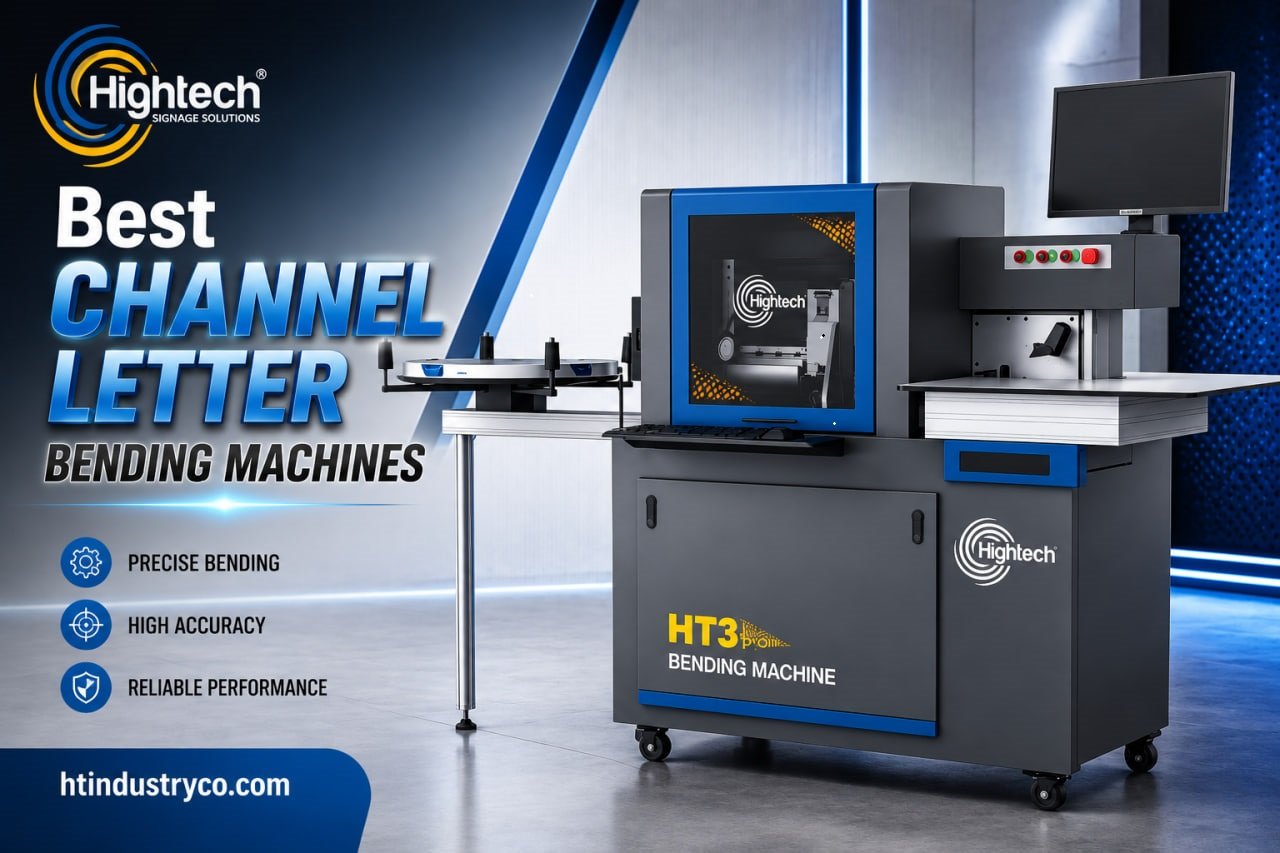
Table of Contents
A channel letter bending machine is a CNC metal-forming system that feeds, slots, bends and cuts coil or strip metal into the returns (side walls) of illuminated channel letters. The right machine decides how fast your shop turns a cut face into a finished, light-ready letter — and how consistent each one looks. This guide compares the five benders Hightech currently builds, using the verified specifications published on each product page, so you can match a model to your material, letter size and production volume before requesting a quote.
Quick Picks
Best for high-volume production: HT PRO — fully automated feed-slot-bend-cut, handles aluminum, galvanized strip and stainless steel, and is positioned to replace 10–20 manual workers.
Best for wide / thick material & top precision: HTZ5 — robotic feeding on a cast body with servo + ground ball screw, ±0.1 mm accuracy, no pinch marks.
Best for stainless-steel signage: HT3 — circulation-clamp feeding with double-blade alternate bending and automatic rebound compensation.
Best flexible all-rounder / entry point: HT1 (aluminum-focused, ±0.01 mm feed encoder) and HT6 (simple, software-calibrated aluminum bender) suit shops building their first automated line.
Hightech Best Channel Letter Bending Machines Compared
Hightech Industry Group manufactures five channel letter bending machines, with sales in 110+ countries and lifetime after-sales technical support. The lineup spans entry-level automation to a high-speed servo flagship, so a shop can match the machine to its volume and material mix. The table below uses verified specifications from each product page.
Model | Materials | Thickness | Letter height | Input files | Min. bend radius |
|---|---|---|---|---|---|
HTZ5 | Aluminum, galvanized, stainless steel | 0.3–1.2 mm | — | AI, DXF, PLT | R15 mm |
HT6 | Channelume, flat aluminum, extrusion, Korean bar, trim cap | 0.3–1.2 mm | 20–180 mm | AI, DXF, PLT | R15 mm |
HT PRO | All aluminum, galvanized, stainless steel | 0.3–1.5 mm | 30–160 mm | AI, DXF | R6–R10 mm |
HT3 | Flat aluminum, galvanized, iron, stainless steel | 0.3–1.2 mm | 10–130 / 10–200 mm (opt.) | DXF | R7–8 mm |
HT1 | Aluminum extrusion, Channelume, flat aluminum, single-edge | 0.3–1.2 mm | 20–130 mm | AI, DXF, PLT | R15 mm |
HTZ5 — best for wide, thick material and maximum stability
The HTZ5 channel letter bending machine is the precision-and-stability flagship. Its integrally cast feeding structure and robot body prevent pinch marks, while customized servo motors, a grinding-grade ball screw and linear guide rail drive fast, accurate motion under an ADTECH motion-control system.
- Materials: aluminum plate, galvanized sheet and stainless steel.
- Accuracy: maintains ±0.1 mm across bending and slotting; minimum bend radius R6 mm; notch angles 30°/120°.
- Build: servo double-blade alternating bending, servo planer slotting, robotic feeding; ~700 kg, 3000×1300×1620 mm.
Best for: shops forming wide or thick stock that need the steadiest, mark-free feeding in the range.
HT PRO — best for high-volume, mixed-material shops
The HT PRO channel letter bending machine is the most versatile machine in the range, combining the strengths of the HT1 and HT3 in one cost-effective platform. It performs auto feed, auto slot, auto bend and automatic cutting-depth adjustment, and completes a letter return or outside with a single click of the Run button.
- Materials: all aluminum types, galvanized strip and stainless steel.
- Material height: 30–160 mm; thickness 0.3–1.5 mm (.012–.059″).
- Build: double alternate-blade bending, rolling feed device, 360° adjustable milling cutter and planer knife, single-phase AC220V / 2.4 kW; CE certified.
- Why it wins: Hightech positions it to replace 10–20 manual workers, making it the natural pick when one machine has to carry a busy shop.
Best for: sign shops that need one automated machine to handle the widest mix of materials at scale.
HT3 — best for stainless-steel and flat-aluminum letters
The HT3 channel letter bending machine is engineered specifically for stainless steel and flat aluminum. A circulation-clamp feeding system keeps material moving with minimal friction and surface damage, while automatic calibration applies intelligent rebound compensation so bent returns hold their shape on complex curves.
- Materials: flat aluminum, galvanized strip, iron strip and stainless steel.
- Material height: 10–130 mm, with 10–200 mm optional; thickness 0.3–1.2 mm; ±0.1 mm accuracy.
- Build: double-blade alternate bending, dual-servo encoder-controlled planer-knife slotting, regrindable blades for lower running cost; single-phase AC220V / 2.4 kW.
Best for: high-end, polished stainless-steel signage and lightweight flat-aluminum letters
HT6 — best for straightforward aluminum production
The HT6 channel letter bending machine is a clean, easy-to-operate aluminum bender. Automatic calibration and upgraded software keep bends repeatable with minimal setup, and a roller feeding system with auto-straightening keeps material handling smooth. Japanese photoelectric sensors support stable, long-running performance.
- Materials: Channelume, extrusion profile, flat aluminum, Korean bar and metal trim cap (all standard aluminum).
- Material height: 20–180 mm; thickness 0.3–1.2 mm; ±0.1 mm accuracy; minimum bend radius R15 mm.
- Build: milling-cutter cutting, double-rod linkage bending, rolling feed; single-phase AC220V / 1 kW; CE certified.
Best for: shops that want dependable, low-fuss aluminum letter production and an easy learning curve.
HT1 — best flexible all-rounder for precise aluminum work
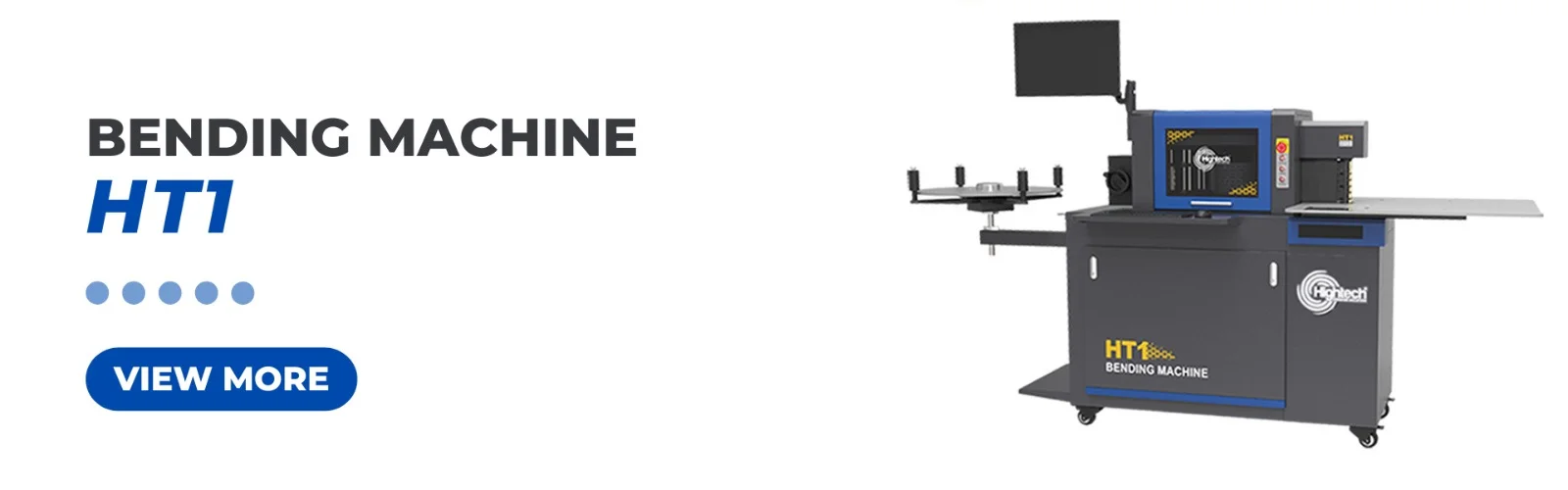
The HT1 channel letter bending machine pairs a high-precision feed encoder (±0.01 mm) with in-house bending software featuring multi-point grooving, tool-radius compensation and a “material memory” function for one-click material changes. A reinforced cutting and grooving system with a 75 mm blade and automatic angle recognition keeps grooves steady regardless of temper or thickness.
- Materials: aluminum extrusion profile, Channelume, flat aluminum and single-edge strip.
- Material height: 20–130 mm; thickness 0.3–1.2 mm; ±0.1 mm forming accuracy with ±0.01 mm feed tolerance.
- Build: 360° milling cutter for front-and-back angled cuts, double-rod linkage bending for scratch-free returns, high-torque motors for 24/7 duty; single-phase AC220V / 1 kW.
Best for: shops prioritizing fine feed precision on aluminum and a flexible single-machine setup.
How to choose the right channel letter bender
The best bender for you depends on four things. Work through them in order:
1. Production volume
Higher-volume shops benefit most from a single fully automated machine that handles the whole feed-slot-bend-cut cycle. The HT PRO is built for exactly this and is positioned to replace the output of 10–20 manual workers. Lower-volume or first-time buyers can start with the HT1 or HT6 and still get full automation.
2. Material
If you bend stainless steel, choose a machine that explicitly lists it — the HT PRO, HTZ5 and HT3 all do. If your work is aluminum strip, profile and Channelume, the HT1 and HT6 are purpose-built for it. Match the machine to what you actually run most days, not the occasional job.
3. Letter height and material thickness
Check that your typical return depth falls inside the machine’s material-height range (for example 30–160 mm on the HT PRO, up to 200 mm optional on the HT3) and that your stock sits within the 0.3–1.5 mm thickness window. Going wider or thicker than rated is the most common cause of poor bends.
4. Budget and footprint
The HT PRO is positioned as the cost-effective, do-everything option, combining capabilities of the HT1 and HT3. Premium precision and a heavier cast body (the HTZ5 weighs roughly 700 kg with a 3000×1300×1620 mm footprint) cost more but pay back on wide-format and high-stability work.
Find the Right Machine for Your Application
Frequently asked questions
What is the best channel letter bending machine in 2026?
There is no single best machine — it depends on your work. For a busy shop running mixed materials, the HT PRO is the strongest all-round choice. For wide or thick stock and maximum stability, the HTZ5 leads; for stainless-steel letters, the HT3; and for precise aluminum work or a first automated line, the HT1 or HT6.
Which channel letter bender is best for a small sign shop?
The HT1 or HT6 are the most approachable. Both are fully automated but simpler to learn and aluminum-focused, so a smaller shop can get to clean, repeatable letters quickly. Step up to the HT PRO once volume or stainless-steel demand grows.
How long do channel letter benders last and what maintenance is needed?
With routine maintenance, these machines are built for years of daily use. Durable servo and ball-screw construction supports continuous workshop operation; keeping blades, feed components and slotting tools in good order is what preserves bending accuracy over time.
Latest contents